
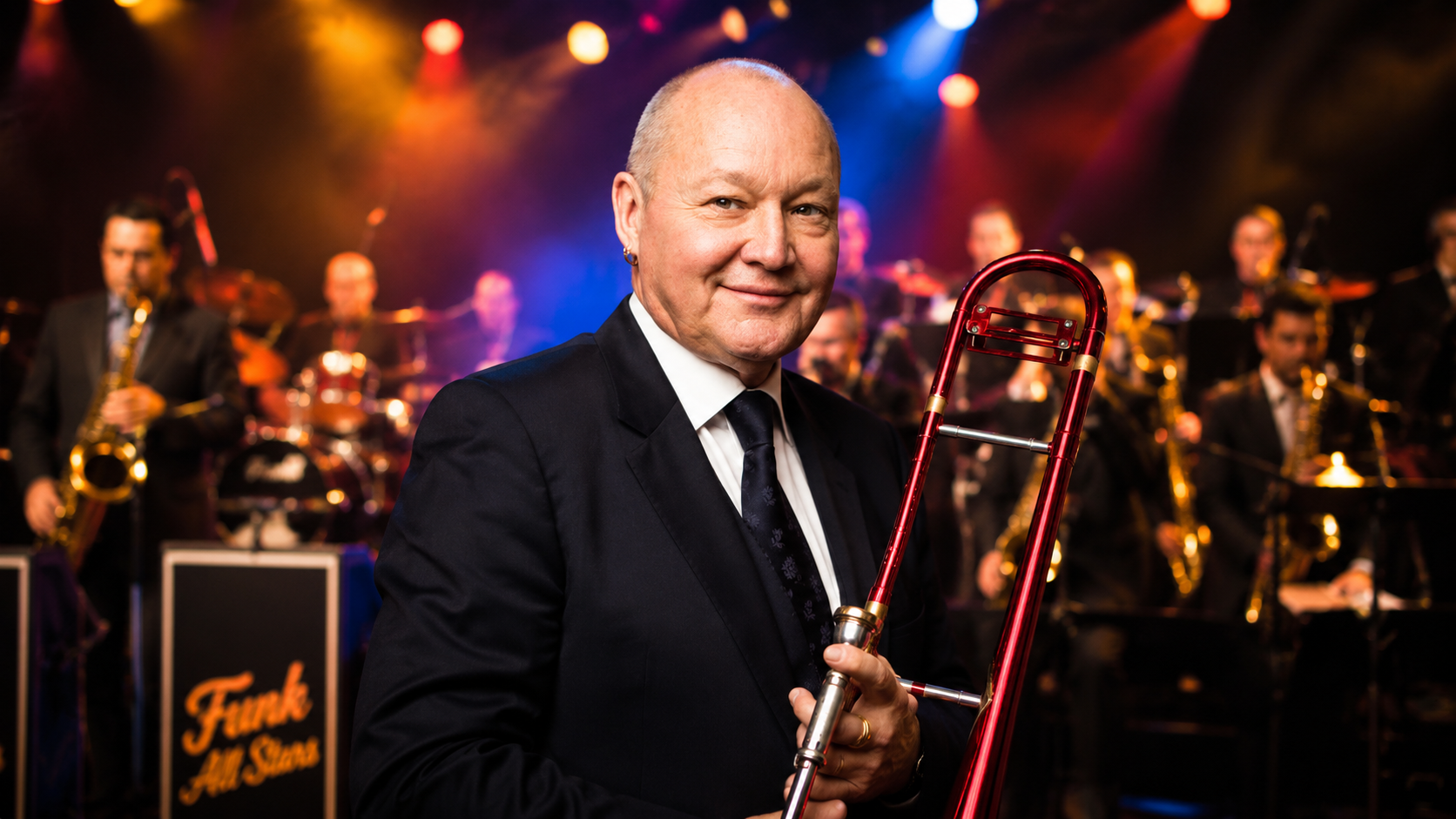
NILS LANDGREN — THE MAN, THE GROOVE AND THE RED HORN
Words by GO! Dubai Press & Media
An exclusive conversation with one of the world’s most celebrated trombonists
There are musicians who play notes, and then there are musicians who make you feel something.
Nils “Nisse” Landgren belongs firmly in the second category. For decades, the Swedish trombonist has taken his unmistakably warm sound, infectious groove and extraordinary musical sensitivity to stages around the world. From jazz and soul to funk, pop and big-band music, his career has been defined by curiosity, collaboration and an almost relentless love of performing.
He formed the Nils Landgren Funk Unit in 1992, and the band has since become one of the defining European forces in jazz-funk. In 2024, the Funk Unit celebrated 30 years with the album RAW. Landgren has also worked with some of the biggest names in international music and has been a Yamaha artist for more than 35 years, playing his unmistakable red signature trombone.
GO! Magazine: Nils, what does music mean to you after all these years?
Nils Landgren: Music is my life. It is not simply something I do for a living. It is the way I communicate, the way I meet people and the way I understand the world.
Every time I walk onto a stage, something different can happen. That is the magic. You can rehearse a piece a hundred times, but when you perform it in front of an audience, the atmosphere changes everything. You listen to the musicians around you, you listen to the audience and you react in the moment.
That is why I still love playing live.
GO!: Your sound is incredibly recognizable. How important is the feeling behind the notes?
Nils: It is everything.
Technique is important, of course. You need to know your instrument and you need to practice. But technique without feeling doesn’t move people.
For me, the trombone has a human quality. It can whisper, sing, shout and cry. I have always tried to find my own voice on the instrument rather than simply trying to play faster or louder.
The groove is equally important. Whether I am playing jazz, funk, soul or something completely different, I want the music to breathe. I want people to feel it in their bodies.
GO!: And then there is that red trombone.
Nils: (laughs) Yes, the red horn has certainly become part of my identity!
It is a wonderful instrument, and Yamaha and I have had a fantastic relationship for many years. The red trombone is immediately recognizable, but for me it is not about having a gimmick. It is about having an instrument that allows me to express myself.
Eventually, an instrument becomes part of your musical personality. You know how it responds, how it feels and how it speaks.
The red trombone has travelled an awful lot of kilometres with me!
GO!: Your Funk Unit has been together for more than three decades. What keeps that music alive?
Nils: People.
Music is about relationships. When you play with musicians for many years, you develop a kind of musical shorthand. You can look at somebody on stage and know exactly what they are thinking.
But you also have to remain curious. The Funk Unit has changed and developed over the years. We have never wanted to simply repeat ourselves.
The groove has to remain alive.
Our 30th anniversary album RAW was a great example of that. We went into the studio with the history of the band behind us, but we wanted the music to sound fresh and honest. Everyone contributed, and the music grew from that collaboration.
GO!: You have played countless festivals and concert halls around the world. What makes a great live performance?
Nils: The connection.
It doesn’t matter if there are 200 people or 20,000. If the audience and musicians connect, something special happens.
There are moments on stage when everything suddenly locks together — the rhythm section, the horns, the audience, the atmosphere. You stop thinking about the technical side of playing and simply become part of the music.
Those moments are addictive.
GO!: Live music has faced enormous challenges. Venues are disappearing, budgets are tighter and audiences have so many other entertainment choices. Does that worry you?
Nils: Of course it does.
Live music needs places where musicians can perform. It needs promoters who believe in artists. It needs audiences who are willing to leave their homes, buy a ticket and experience something together with other people.
That ecosystem is fragile.
But I am also optimistic. Music has survived enormous changes before. Formats change, technology changes and the music business changes, but people’s need for music does not disappear.
GO!: We are now surrounded by artificial intelligence, computers and increasingly sophisticated machine-generated music. Can real musicians compete?
Nils: I believe good music will always win.
Technology can reproduce sounds. It can create incredibly sophisticated things. But music is more than sound.
When five musicians stand on a stage and listen to one another, there is a human exchange taking place. Somebody makes a tiny mistake, another musician reacts, the drummer changes the groove, the audience responds — and suddenly the music goes somewhere nobody planned.
You cannot completely program that human experience.
A machine can imitate a feeling. A human being can actually feel it.
GO!: After such a long career, what still excites you?
Nils: The next concert!
I still get excited before walking onto a stage. I still want to hear what happens when the band starts playing.
And I still want to meet musicians who challenge me and teach me something.
That is probably why I have never wanted to stop exploring. Jazz and funk are not museums. They are living music.
GO!: Finally, what would you say to a young musician wondering whether there is still a future in live music?
Nils: Play.
Play as much as you can. Listen to other musicians. Learn your instrument. Go to concerts. Make mistakes. Find your own sound.
And don’t become obsessed with being perfect.
Music is communication. If you can make another human being feel something, you have already achieved something important.
After more than five decades surrounded by music, Landgren remains remarkably optimistic. His career — from the legendary Thad Jones Big Band to the international stages of the Funk Unit, collaborations with artists across genres, and his work as a mentor and festival leader — reflects a musician who has never stopped moving forward.
And somewhere beneath the stage lights, there is usually that unmistakable flash of red.
The red horn.
Still grooving. Still singing.
Still very much alive.
